

Understanding Construction Risk
Construction projects have never been easy to manage. Every project involves tight schedules, changing site conditions, multiple subcontractors, heavy equipment, suppliers, and hundreds of moving parts that need to work together.
As projects become larger and more complex, so do the risks.
Construction companies today face five major types of risk:
Design errors, poor workmanship, or defective materials that lead to costly rework and project delays.
Worker injuries, heavy equipment incidents, falls, electrocution, and other site hazards that put both people and projects at risk.
Rising material costs, labor shortages, cash flow issues, and unexpected project costs that affect profitability.
Contract disputes, change orders, expired certifications, insurance gaps, and regulatory requirements that can delay projects and increase liability.
Delays caused by supply chain disruptions, bad weather, labor shortages, equipment breakdowns, and poor project coordination.
The challenge isn't identifying these risks.
It's identifying them early enough to do something about them.
Most construction companies only discover a problem after it has already affected the project. A delayed material delivery leaves crews waiting. A machine breaks down during a critical phase. A subcontractor's insurance expires halfway through the project. Bad weather forces work to stop with little time to adjust.
By then, the project is already losing time and money.
More than 70% of construction projects experience delays or budget overruns, putting constant pressure on contractors to improve visibility, reduce uncertainty, and make faster decisions.
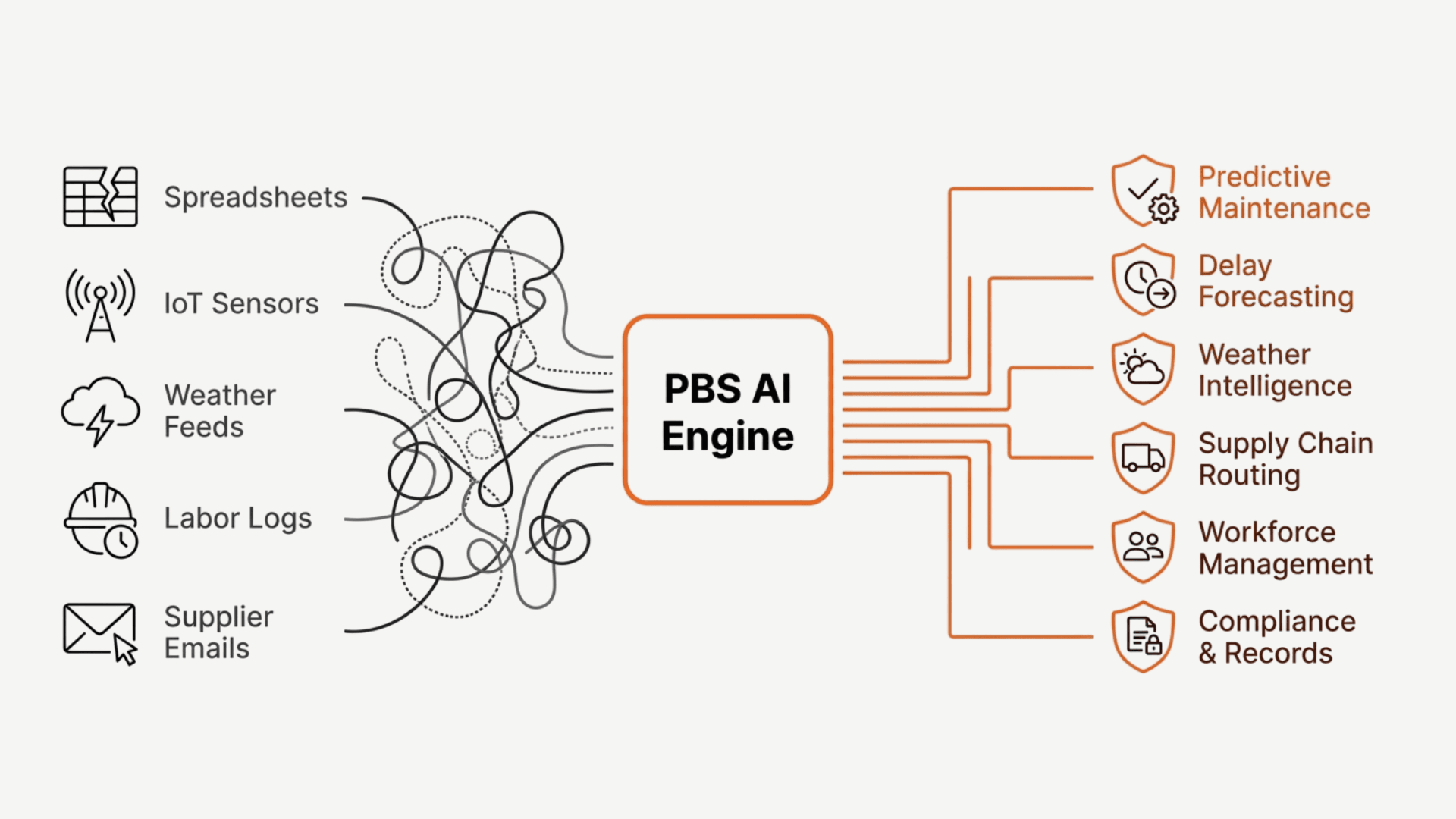
This is where AI is changing construction risk management.
Instead of reacting after problems occur, AI analyzes project data as work progresses, identifies patterns across equipment, schedules, suppliers, labor, safety, and compliance, and highlights potential risks before they become expensive problems.
Project managers aren't replacing experience with AI.
They're using AI to make better decisions, reduce uncertainty, and keep projects on schedule.
How AI Is Improving Construction Risk Management
Artificial intelligence doesn't replace experience or decision-making but actually helping the companies make wiser decisions.
AI can process thousands of pieces of information from across a project at the same time. Equipment performance, labor availability, supplier updates, weather forecasts, project schedules, safety reports, compliance records, and historical project data can all be analyzed together instead of separately.
Rather than simply reporting what has already happened, AI looks for patterns that indicate what is likely to happen next.
For example, it can identify equipment that is beginning to show signs of failure before it breaks down. It can detect when several small scheduling issues are likely to combine into a major project delay. It can monitor supplier performance and recommend alternatives before materials become unavailable. It can also help identify safety risks before an incident occurs.
Instead of reacting to problems every day, project teams can start preventing them.
For construction companies, this means fewer unexpected delays, better planning, improved communication between departments, and more confidence when managing complex projects.
The following are some of the most practical ways construction companies are using AI to build a more proactive approach to risk management.
The AI Intervention
Unexpected breakdowns
IoT sensors monitor vibration and temperature to detect early failure patterns
Unplanned downtime, idle crews
Minor delays accumulating
Unifies labor, material, and weather data to calculate daily delay probabilities
Missed milestones, late penalties
Sudden changes halting work
72-hour hyperlocal forecasts updated every 6 hours, flagging operational limits
Unsafe conditions, rework
Discovered at delivery failure
Monitors supplier reliability; maintains a tiered backup network
Material shortages, schedule disruptions
Disconnected claims and logs
Auto-surfaces incident reports and near-misses into a single audit trail
Labor shortages, compliance risks
Missed requirements
Acts as a second brain to organize and remind teams of missing certifications
Client disputes, expired docs
Searching multiple systems for evidence
Keeps all project documentation connected and searchable for specific events
Delayed claims, legal costs
Predictive Maintenance
THE CHALLENGE
Heavy equipment keeps construction projects moving. When a crane, excavator, generator, or concrete pump unexpectedly breaks down, it can delay an entire sequence of work, leave crews idle, and increase repair costs.
Most companies only discover these issues after the equipment has already failed.
HOW AI HELPS
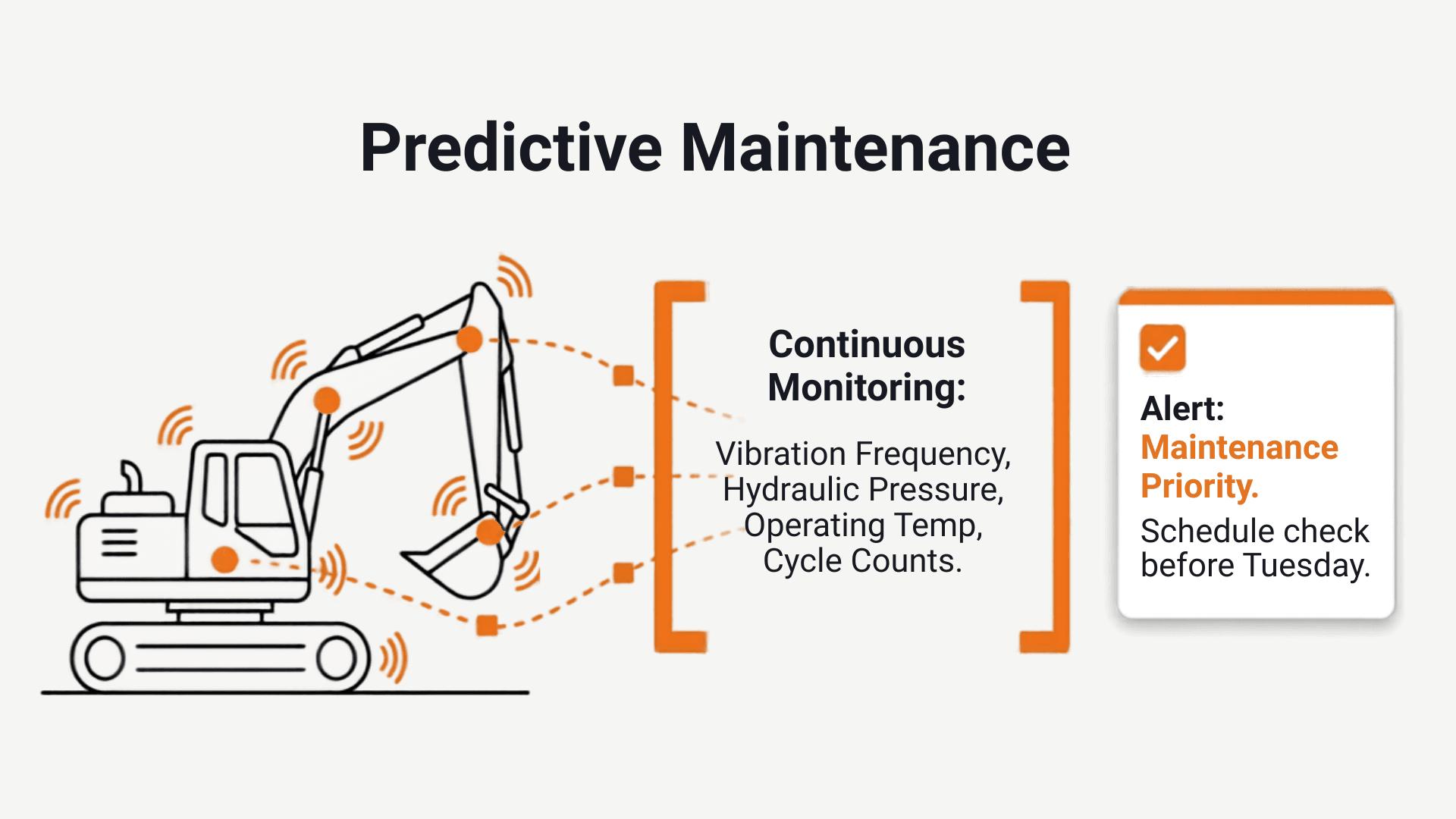
IoT sensors are installed on each machine to continuously monitor vibration frequency, hydraulic pressure, operating temperature, and cycle counts in real time. This data streams into PBS's AI platform where machine learning models, trained on historical failure patterns, analyze it continuously to detect anomalies early.
By analyzing equipment performance, operating hours, and maintenance history, AI can detect early signs of failure before a breakdown occurs. Not only that, it can flag it in the system so maintenance becomes a priority. This gives project managers time to schedule maintenance without disrupting the project.
WHAT RISK IT SOLVES
- Unplanned equipment downtime
- Emergency repair costs
- Idle crews
- Project delays caused by equipment failures
Compliance, Documentation & Legal Risk
THE CHALLENGE
Every construction project comes with contracts, permits, inspections, certifications, safety requirements, and client documentation. As projects grow, keeping track of changing regulations and paperwork becomes difficult, increasing the risk of missed requirements, compliance issues, and future disputes.
HOW AI HELPS
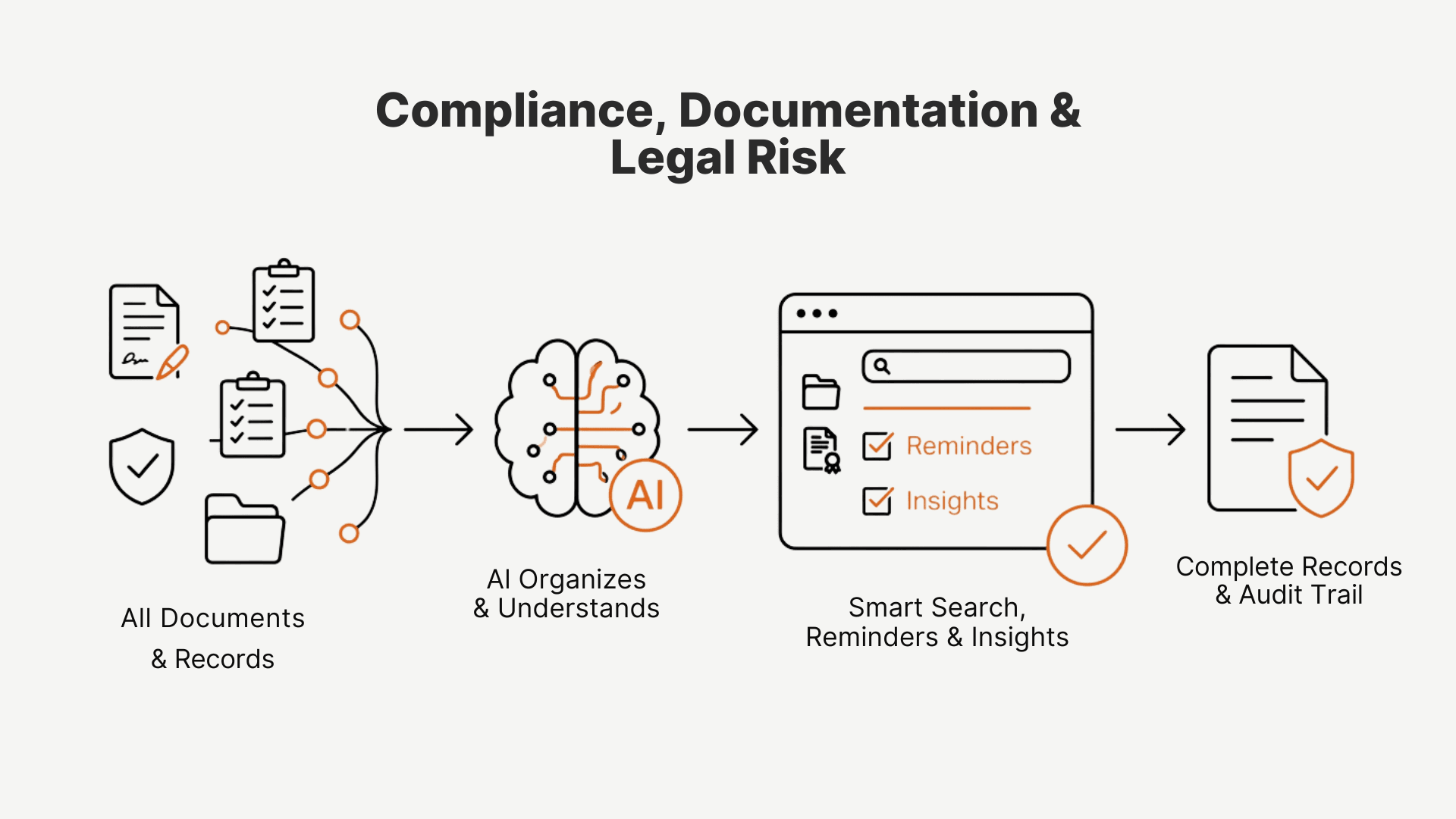
AI acts as a second brain for your business. It can organize permits, contracts, inspection reports, certifications, safety documents, and project records in one place while helping teams quickly find the information they need.
When trained on your company's documentation, AI can also answer internal questions, highlight missing information, remind teams about upcoming requirements, and create a documented history of every project.
This makes compliance easier today while creating stronger evidence if a client dispute, audit, or legal claim arises in the future.
WHAT RISK IT SOLVES
- Compliance issues
- Missing or expired documentation
- Client and contract disputes
- Poor record keeping during legal claims
AI Delay Forecasting
THE CHALLENGE
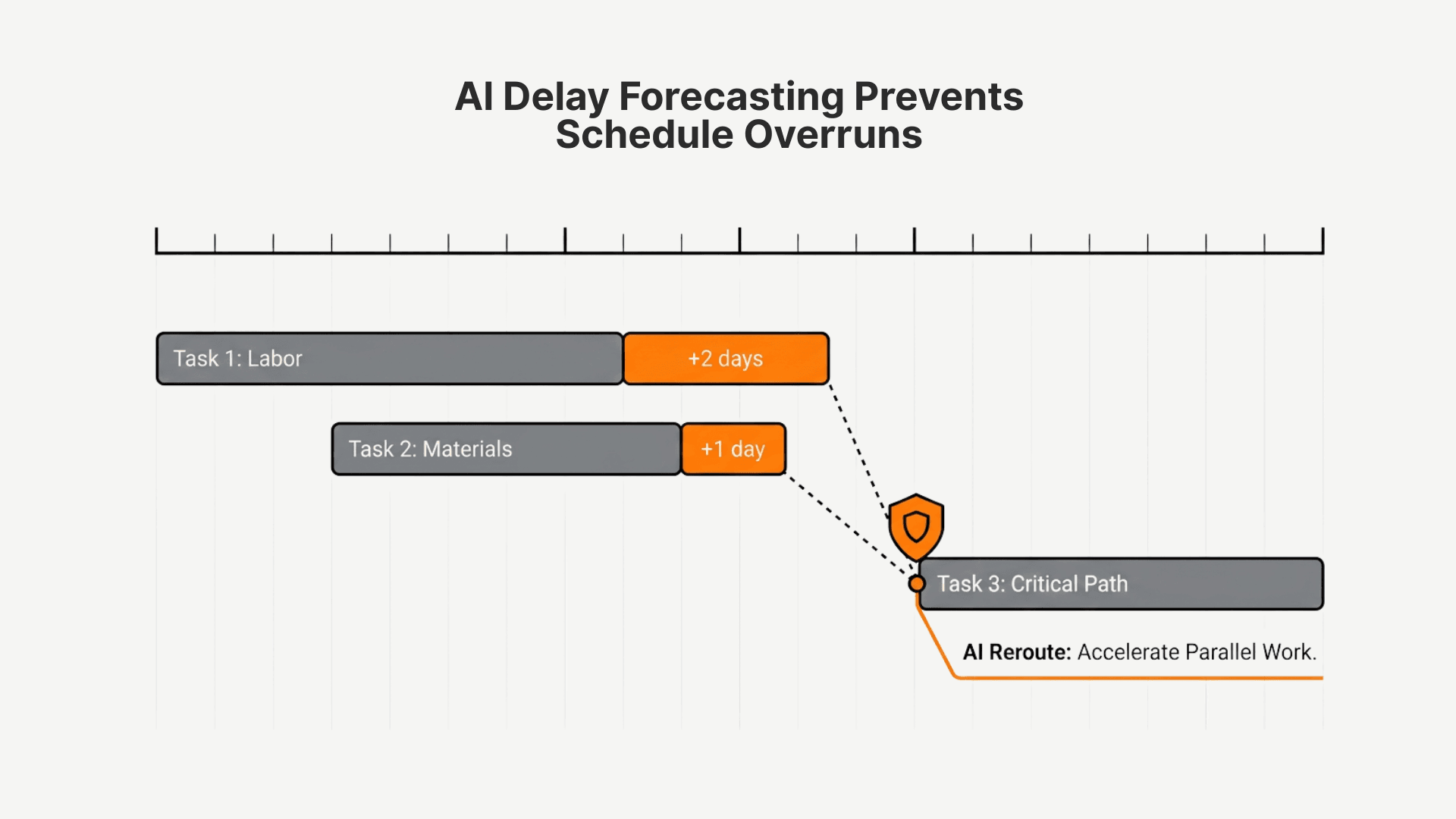
Construction schedules can be disrupted by the accumulation of minor delays: a subcontractor running late, a delayed material delivery, or crew reassignment. Individually these may seem manageable but collectively they can cause major disruptions.
HOW AI HELPS
PBS integrates labor productivity data, material tracking, subcontractor performance, and weather inputs into a unified AI forecasting model. It calculates delay probabilities for each task, crew, and project phase daily. When multiple risk factors converge, the system alerts project managers with enough lead time to reprioritize or accelerate parallel work.
WHAT RISK IT SOLVES
- Missed project milestones
- Schedule overruns
- Late delivery penalties
- Reactive planning
Weather Intelligence
THE CHALLENGE
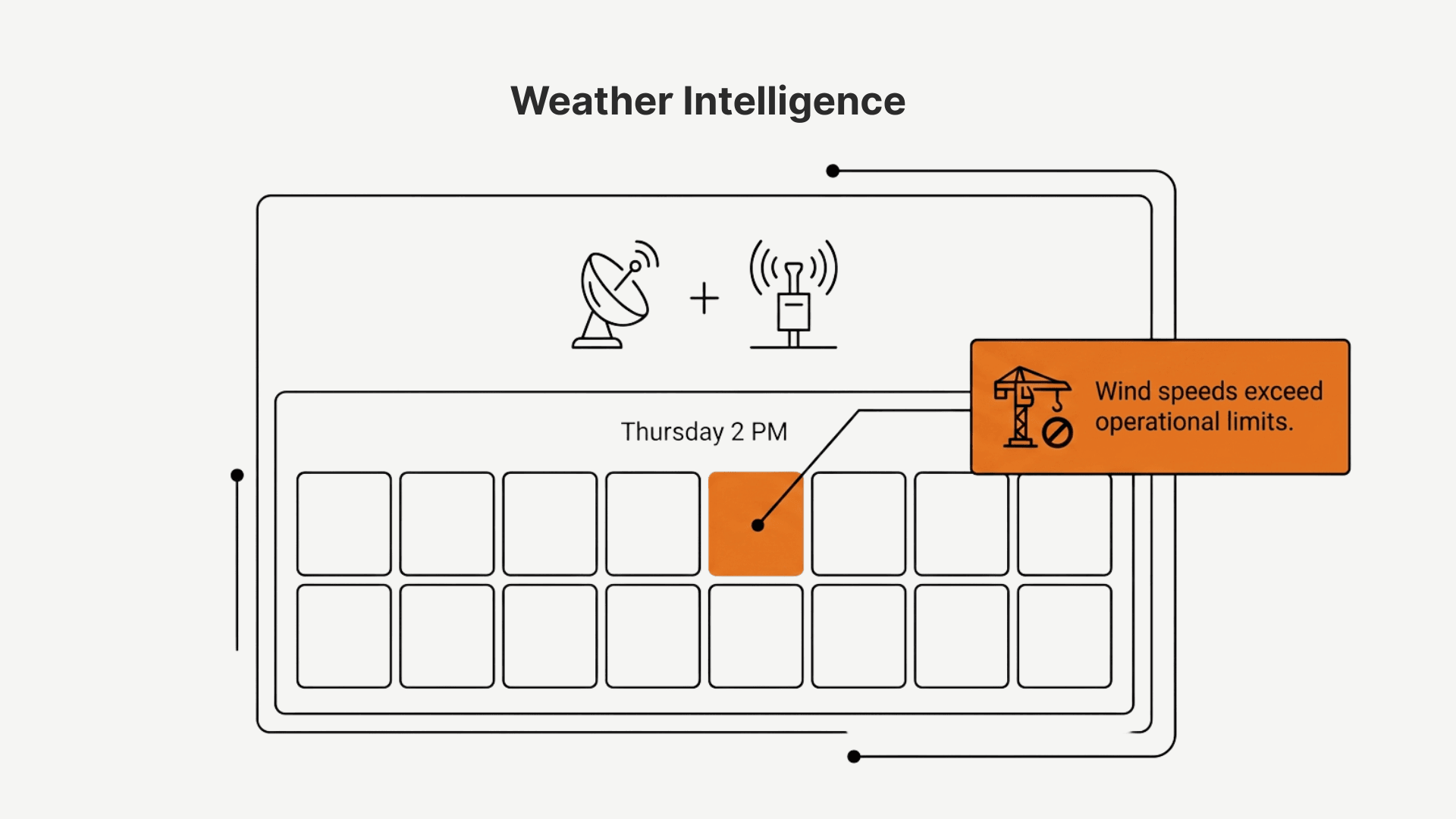
Weather is one of the few risks construction companies can't control. A sudden change in rain, wind, or temperature can delay concrete pours, make crane operations unsafe, and disrupt the project schedule.
HOW AI HELPS
AI can't control the weather, but it can help teams prepare for it. PBS integrates satellite data, regional meteorological feeds, and on-site sensors measuring wind speed, temperature, humidity, and precipitation. Its AI generates hyperlocal, activity-level weather forecasts with a 72-hour planning window updated every six hours. It flags scheduled tasks affected by weather exceeding operational limits, like high winds for crane operations.
WHAT RISK IT SOLVES
- Weather-related project delays
- Unsafe working conditions
- Equipment downtime
- Rework caused by poor weather conditions
Supply Chain Monitoring
THE CHALLENGE
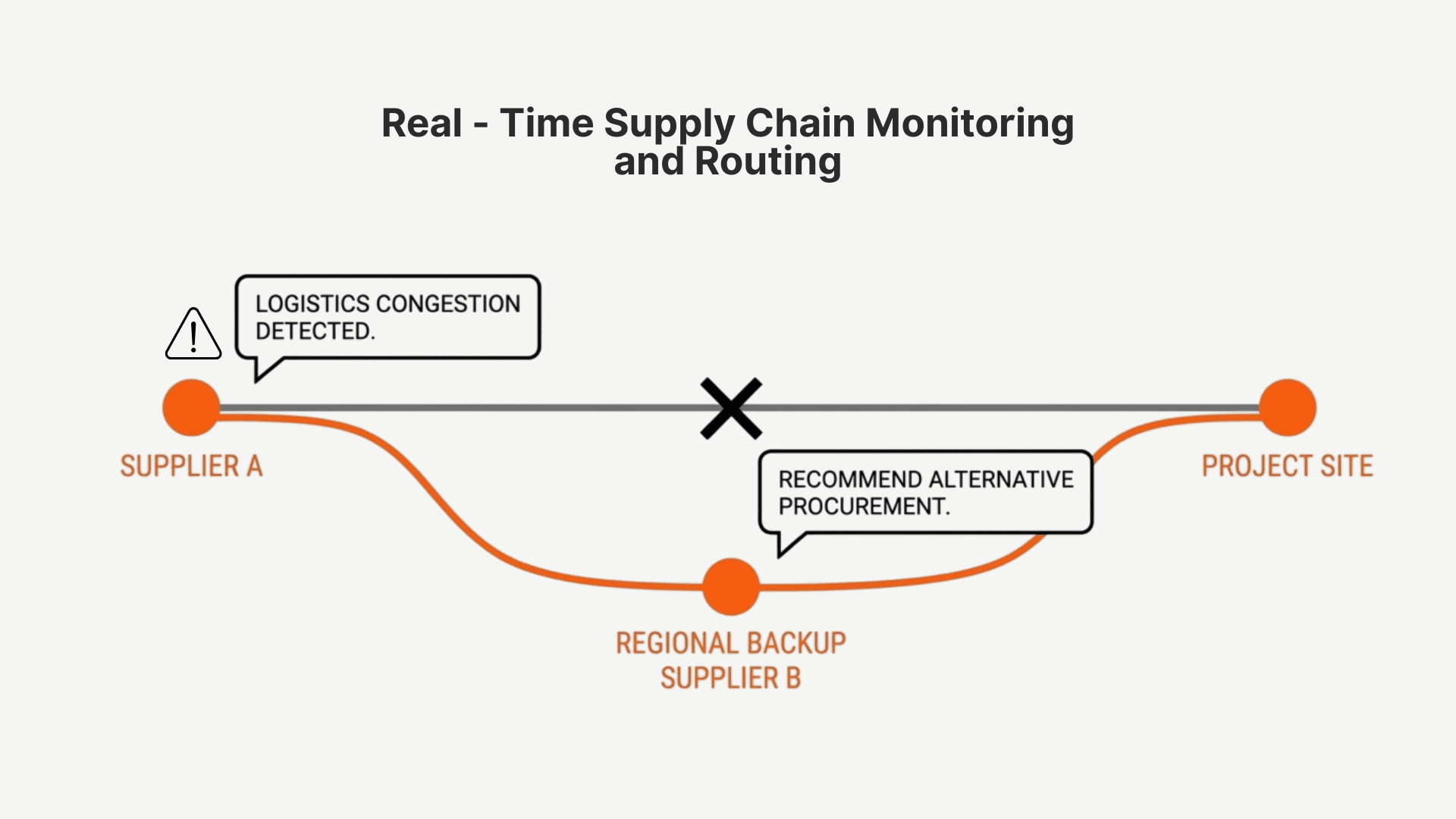
Material price volatility and supplier failures are among the most unpredictable and expensive risks. Most firms only discover supply disruptions when a delivery fails to arrive.
HOW AI HELPS
AI monitors supplier performance, delivery schedules, and procurement activity to identify potential disruptions early.
PBS Solution: PBS connects directly with supplier systems, logistics platforms, and commodity price feeds. Its AI continuously monitors supplier reliability, regional logistics congestion, and pricing trends. The platform maintains a tiered supplier network with primary, secondary, and regional backups for each material category. It can recommend alternative suppliers or highlight materials that should be ordered sooner, helping teams avoid unnecessary delays. It basically can manage supplies for you according to your projects.
WHAT RISK IT SOLVES
- Supplier delays
- Material shortages
- Last-minute procurement decisions
- Schedule disruptions
- Complete market data
Workforce & Third-Party Management
THE CHALLENGE
Construction projects rely on both skilled workers and subcontractors. Claims for workers' compensation, equipment damage, contract disputes, and third-party liabilities often live in disconnected systems, delaying resolution and increasing costs.
HOW AI HELPS
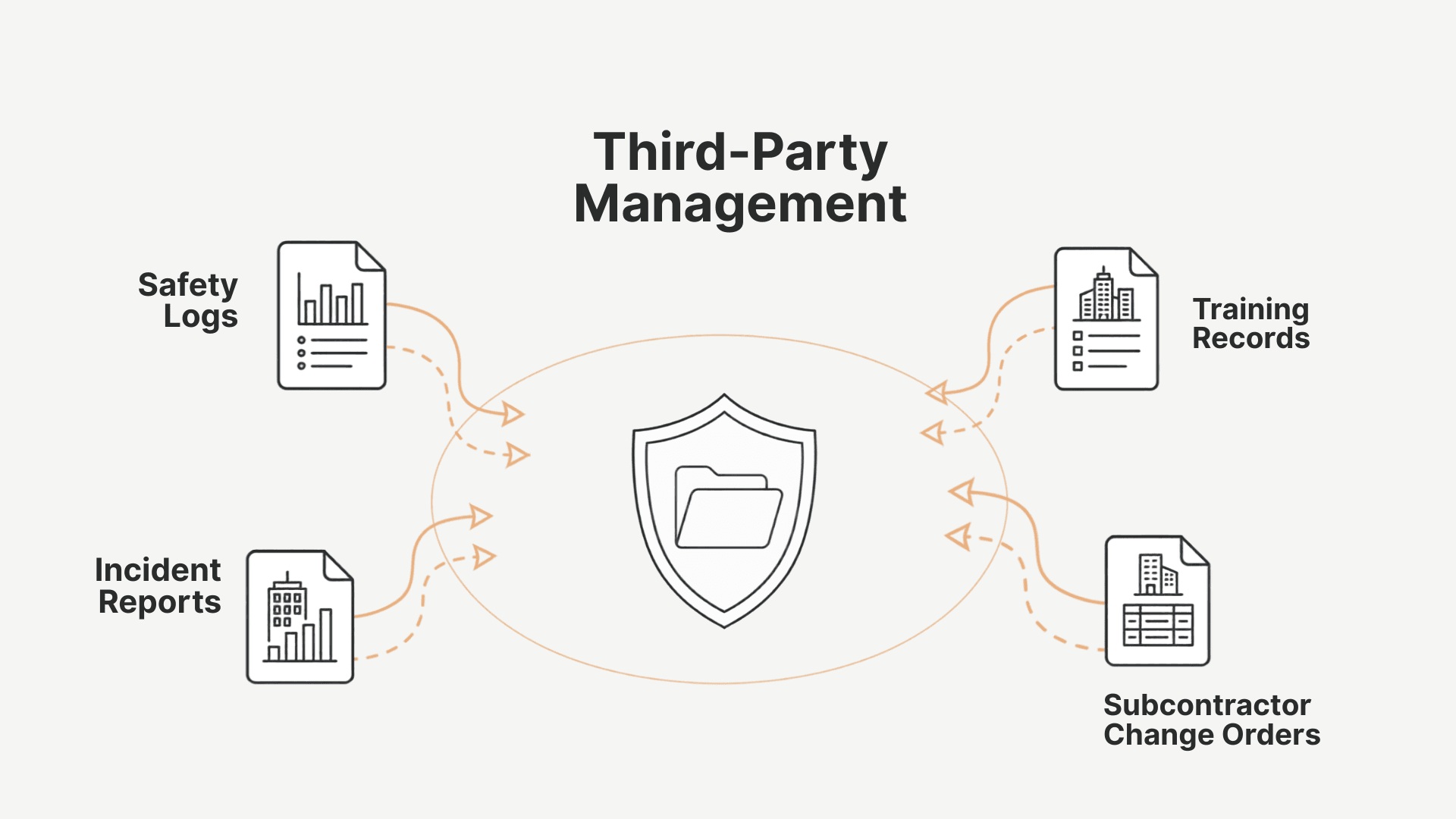
PBS Solution: PBS links claims data directly with safety incidents, site documentation, subcontractor records, and project timelines. For workers' compensation, it auto-surfaces incident reports, safety logs, training records, and near-miss reports. For contract claims, it integrates change orders, daily logs, weather, and schedules into a single audit trail for quick reconstruction.
WHAT RISK IT SOLVES
- Labor shortages and work stoppages
- Expired certifications or insurance
- Reduced legal costs
- lowers insurance premium increases from unresolved claims.
- Delays caused by unavailable subcontractors
- Compliance risks across third-party teams
Claims & Project Records
THE CHALLENGE
When a dispute or insurance claim happens, finding the right documents can take days. Site reports, emails, daily logs, photos, change orders, and contracts are often spread across multiple systems.
HOW AI HELPS
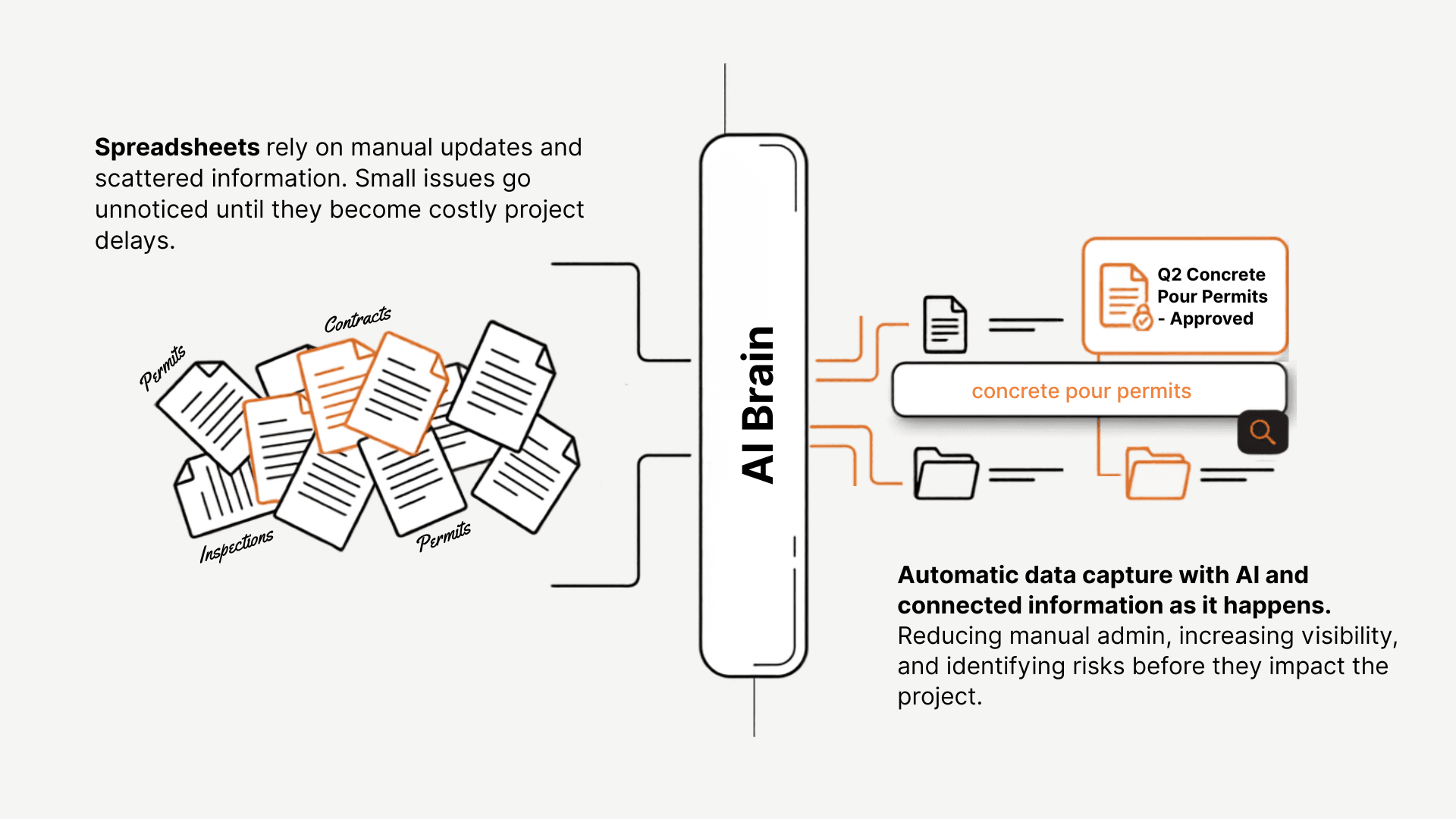
AI keeps project documentation connected and searchable. Instead of manually collecting evidence, teams can quickly access the records, timelines, communications, and project documents related to a specific event.
A well-documented system not only speeds up claims but also strengthens client relationships by providing clear, transparent records whenever questions arise.
WHAT RISK IT SOLVES
- Delayed claims
- Missing documentation
- Legal costs
- Client disputes
Why a Connected AI System Matters
Each of these solutions is valuable on its own.
But the real advantage comes when they're connected.
A supplier delay affects the schedule. A schedule change impacts labor planning. Bad weather changes site activities. Compliance requirements influence project delivery. None of these risks exist in isolation.
A connected AI system brings all of this information together, giving project teams one place to manage equipment, schedules, procurement, workforce, documentation, and compliance.
Instead of reacting to problems after they've happened, teams gain the visibility to identify risks earlier, make better decisions, and keep projects moving.
Most construction companies already have the data they need, and in many cases they have been using it well enough, but the real opportunity is to turn that data into a system that improves efficiency, because the problem is not the lack of information, it is that the information is scattered across different software, spreadsheets, emails, and project documents, which means updates get missed, visibility drops, and small issues around supplies, progress, and coordination turn into delays.
A lot of this still lives in spreadsheets, and while spreadsheets are useful, they are not updated instantly, they take admin time, and they usually depend on someone remembering to enter the information later, whereas AI has an advantage because it can capture and organise information as it comes in.
A purpose-built AI system connects to the tools you already use, learns from your historical project data, and understands how your business operates, so instead of replacing everything you already have, it fills the gaps between your systems and gives you one connected view of every project.
What that means in practice is simple: project managers spend less time chasing updates from different teams, leadership gets a clearer view across projects, and important information is documented, searchable, and available when it is needed, whether that is for planning, compliance, or resolving a client dispute.
On the ground, that means fewer unexpected delays, less equipment sitting idle, better workforce planning, faster decisions, and fewer costly mistakes, because when the right information is available at the right time, teams can act earlier and manage problems before they grow.
At RipeSeed, we have helped build purpose-built systems around the way companies already work, and we are actively researching how this can be applied across construction and home services, because we see the opportunity not just to improve oversight, but to give businesses a real competitive edge.
Not sure where to start?
Talk to RipeSeed About Your Risk Workflow
If you are exploring how this could fit your business, or even if you are not sure it would, we would still be happy to talk.
In an industry where every delay affects your margin, better visibility is not just useful, it is a competitive advantage.