
June 2026 Update: Open Source & Client Wins
June was a strong month for open-source contributions across Apache Superset, Airflow, Prefect, and Zulip, with 12 PRs (six merged). We also highlighted client wins and released practical engineering videos for scalable architectures.
RipeSeed Team—Editor
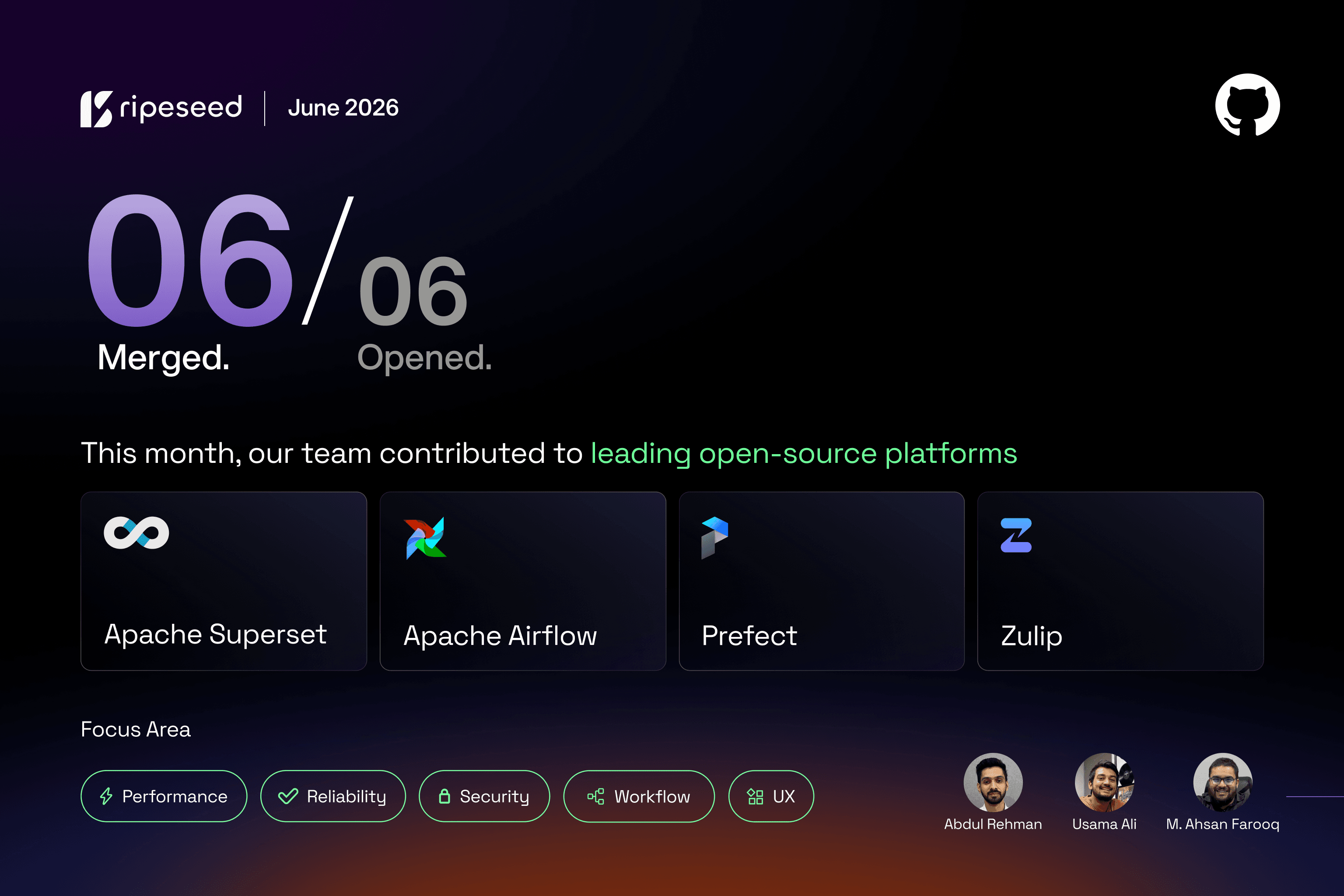
June was another strong month for the team as we continued contributing to open source, shared practical engineering knowledge with the developer community, and delivered products that strengthened the relationships we've built with our clients.
We genuinely enjoy contributing to open source because it keeps our engineers close to real production problems, exposes us to large-scale systems used by thousands of organizations, and gives us the opportunity to give back to the tools we rely on every day while continuously improving our own engineering standards.
This month, Abdul Rehman, Usama Ali, and M. Ahsan Farooq opened 12 pull requests across Apache Superset, Apache Airflow, Prefect, and Zulip, with six already merged and the remaining contributions progressing through review.
Open Source Contributions
Apache Superset
A significant part of this month's work went into Apache Superset, where we focused on improving performance, reliability, and security across several core areas of the platform. We removed redundant database queries on filter-heavy dashboards through smarter per-user caching, fixed stale chart data after refreshes, resolved dataset API collisions across schemas, strengthened MCP authentication so failed permission checks prevent unauthorized access, restored permalink sharing for teams upgrading from Superset 5 to 6, fixed fresh-install crashes caused by a missing dependency, and improved scheduled dashboard reporting by ensuring screenshots are only captured after dashboard state has been fully persisted.
This is the kind of engineering work that often goes unnoticed when everything works, but becomes immediately obvious when it doesn't—which is exactly why it matters.
Apache Airflow
Our Airflow contributions focused on making workflow scheduling more dependable for production teams. We restored custom timetable compatibility in Airflow 3.2, fixed deferred sensors using soft-fail mode so they correctly reschedule instead of being silently skipped, and corrected API logging behavior to prevent ANSI escape codes from polluting structured log pipelines.
Individually, these are relatively small changes, but together they remove several frustrating edge cases that teams running critical workflows encounter every day.
Prefect
In Prefect, we focused on improving orchestration reliability by eliminating unnecessary operational noise and resolving an important execution edge case. Duplicate "Late Run" alerts have been eliminated, and flow executions stored inside Git repositories now correctly wait for the repository to be pulled before attempting imports.
The result is fewer false alerts, more predictable execution, and significantly less time spent investigating avoidable failures.
Zulip
Our contribution to Zulip focused on improving the reading experience by making navigation more intuitive. Instead of disappearing once a user reaches the bottom of a conversation, the floating scroll button now transforms into a contextual "Next Unread" shortcut, allowing users to move seamlessly through unread conversations without breaking their reading flow.
Small user experience improvements like this may seem subtle, but they make everyday interactions noticeably smoother.
All of these contributions were not just isolated bug fixes. Each contribution addressed real issues affecting production environments, helping make these platforms faster, more secure, more reliable, and ultimately better for the developers who depend on them every day.
What We've Been Publishing

Alongside our open source work, Rizwan published four in-depth engineering videos designed to help developers solve the kinds of architectural problems that rarely get covered in traditional tutorials. Over the years, these are patterns and challenges he has repeatedly encountered while building production software, and he wanted to create a practical resource that explains not only how to solve them, but why these decisions matter in real-world systems.
This month's videos covered:
-
Multi-Domain White-Label SaaS with React: One Codebase, Infinite Brands
-
Role-Based Access Control for Multi-User SaaS Without Breaking Existing Users
-
Building a Zapier Integration for Your SaaS: Triggers, Actions & Webhook Architecture
-
How We Cut MongoDB Costs by 75% Without Users Noticing
The topics represent the engineering decisions that quietly determine whether a product remains scalable and maintainable or gradually becomes difficult to extend. White-label architecture, permission systems, integrations, and database optimization are challenges that almost every growing engineering team eventually faces.
Poor engineering decisions are expensive. They slow delivery, allow bugs to hide for longer, make onboarding new developers more difficult, and increase the cost of maintaining software over time. Rather than focusing on theory, each video walks through a real problem, explains why it happens, demonstrates the solution, and discusses the trade-offs involved. Whether you're an engineer looking to improve your architecture skills or a technical leader trying to build software that remains maintainable as it grows, these videos are intended to provide practical lessons you can apply immediately.
You can watch the full series here: https://www.youtube.com/@RipeSeedio
Client Wins
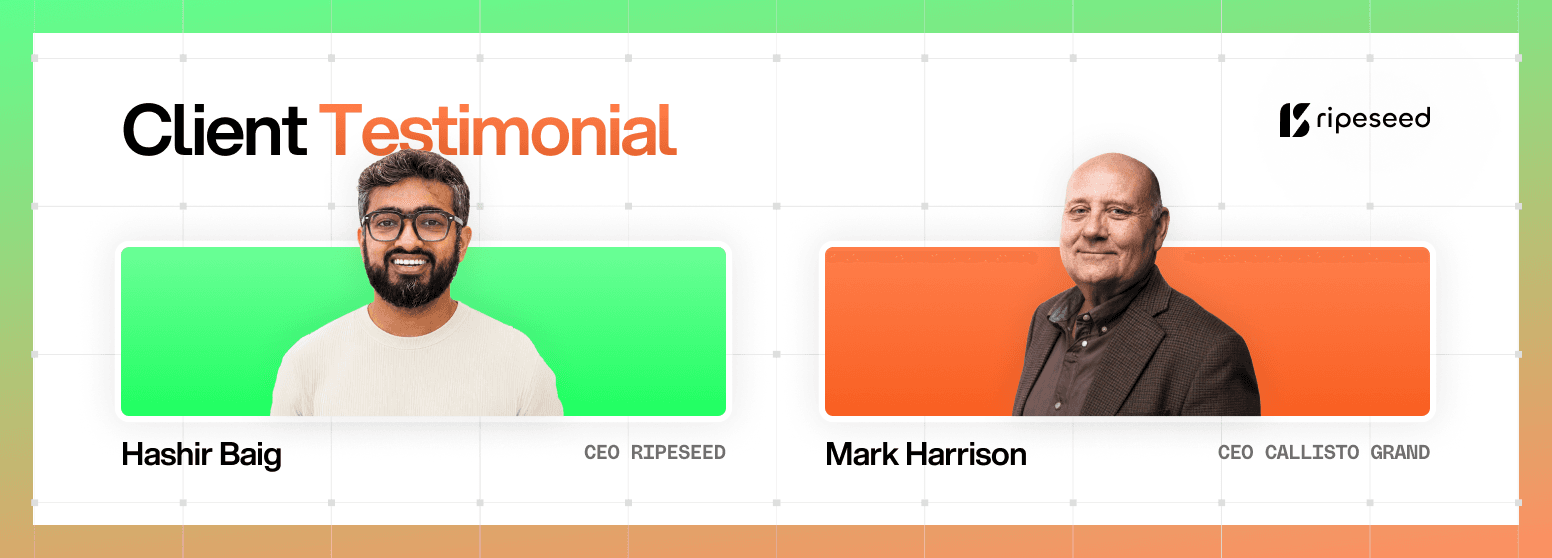
One of the highlights of the month was completing a major phase of work with Mark and his team as we partnered together to build an Order-to-Cash advisory platform.
As the project reached this milestone, Mark described us as "nice people to work with" and also referred to the team as "decent people to work with."
We value feedback like this more than people might expect. Building great software is important, but building strong relationships along the way matters just as much. Comments like these remind us that our work is measured not only by the quality of the product we deliver, but also by the experience of working with our team throughout the journey. Knowing Mark's reputation in the market, we are confident the product is in strong hands, and we genuinely hope it performs well.